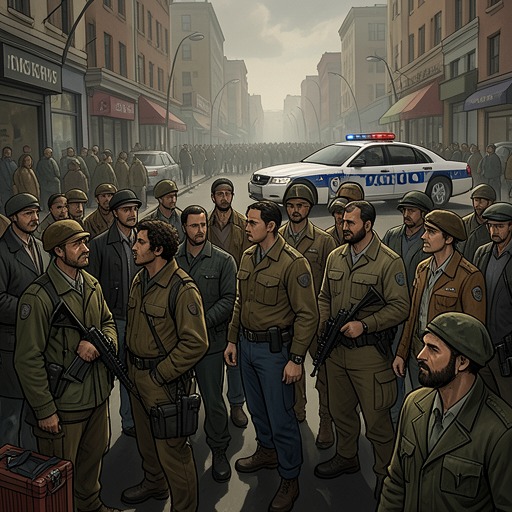
Surveillance and Suppression of the Counterculture
Inherent ViceSurveillance and Suppression of the Counterculture is presented not as the work of a single agency but as a dispersed system: police intelligence units, informants, private operatives, and armed reservists observe and infiltrate dissent, while redevelopment and racialized policing reshape who can occupy Los Angeles and on what terms. The novel’s central irony is that surveillance appears both as official paperwork and as a quieter presence in supposedly carefree gatherings; the counterculture’s openness becomes an opportunity for institutions to classify, recruit, and contain it.
Infiltration and the Informant
The system becomes visible to Doc through television coverage of a rally at Century Plaza, where Richard Nixon addresses activists from Vigilant California. Men in matching suits and ties stand among the crowd without appearing interested in the speech. When a longhaired protester shouts at Nixon and is seized and escorted away, Doc recognizes him as Coy Harlingen. Penny identifies Coy as an informant who works mostly for the Red Squad and the Public Disorder Intelligence Division, converting what first looks like an impulsive protest into a deliberately staged public appearance.
Penny explains the utility of that performance: after appearing on television, Coy has instant, wide credibility and can be infiltrated into groups the police want to observe. The arrangement depends on a contradiction. Coy’s apparent opposition to Nixon makes him legible as a dissenter to other activists, while his actual role makes him useful to the institutions they might distrust. Doc suspects a setup but resists Penny’s interpretation; her warning is that even a private investigator should recognize the political value of an informant whose public image has already been established.
A Climate of Observation
The surveillance in the novel is not confined to rallies or named intelligence units. At a gathering of young people, Doc notices older men who remain rigid and unsmiling while others participate in the event. The repeated greeting, “Where are you at, man?” strikes him as an attempt to classify people quickly, as though anyone who cannot be assigned a category presents a problem. He connects the men’s posture to operatives he has encountered elsewhere: people who collect debts, intimidate, and keep watch for anything that might become a threat.
From that observation, Doc considers whether such crews have been present across concerts, peace rallies, and other countercultural gatherings, reclaiming music, political resistance, and sexual freedom for the forces of greed and fear. The thought is framed as a possibility, not proof of a single coordinated operation. Its importance lies in how the novel makes suspicion arise from recognizable details—the watchers’ posture, their silence, and their repeated presence—while leaving the scale of the network uncertain. The counterculture is not simply confronted at its public demonstrations; it may be watched within the spaces where it imagines itself least governed.
Data, Policing, and Post-Manson Fear
A roadside encounter turns this diffuse monitoring into administrative procedure. After Doc, Denis, Japonica, and Dr. Rudy Blatnoyd are stopped, officers invoke Cultwatch, a purported program under which any gathering of three or more civilians can be treated as a potential cult. Its listed criteria include references to Revelation, men with shoulder-length hair, and “automotive absentmindedness.” The rules make ordinary appearance and conduct into grounds for suspicion, while the officers say that the collected information will be sent to a master data bank in Los Angeles and Sacramento. Unless the names match a want or warrant, the group is told, it will hear nothing further.
The encounter’s bureaucratic tone does not make it reassuring. Denis jokes that their beige Mercedes ought to count in their favor, but Doc observes that the officers are vibrating with the post-Manson nerves prevailing in the area. The scene links the policing of countercultural appearance to a broader public climate in which fear can make expansive monitoring seem reasonable. A list and a database promise neutral record-keeping; in practice, the stated criteria sweep hairstyles, religious references, and incidental behavior into a system of scrutiny.
Reservists and Private Enforcement
Doc later learns from Fritz that some license-plate numbers he supplied belong to members of the Los Angeles police reserves. Fritz says that many joined during the Watts uprising, when they could take part in racist violence under legal cover, and that they have since functioned as a private militia used by the Los Angeles Police Department when it wants help without attracting unfavorable publicity. The information connects the visible machinery of policing to a less publicly accountable reserve force.
Doc investigates this overlap by visiting Arthur Tweedle, a civilian machinist who works at a naval weapons station and attends Vigilant California meetings with his neighbor Prescott. Tweedle is on the list Fritz has compiled of local homeowners concerned with property defense. When Doc mentions his reserve service, Tweedle explains that he is on standby, with his car prepared so he can reach a callout within an hour. He presents the arrangement as useful assistance to the police, who, he says, lack enough patrol cars and uniformed officers to handle a dangerous situation. The language of civic help thus sits beside the reserve network’s racial history and its capacity for private mobilization.
Tweedle also describes weekend urban counterguerrilla maneuvers and occasional assignments to deal with individuals when the authorities cannot commit the necessary manpower. These jobs can mean surveillance or a warning delivered by damaging property; he calls them cash work. His arsenal ranges from small firearms to military-grade weapons, including a two-person automatic bazooka system mounted on a modified electric golf cart. When he makes a racist remark about protecting his property, the racial logic behind the security posture is explicit rather than merely implied.
A Nordic-style ski mask in Tweedle’s workshop recalls footage of the attack on Chick Planet Massage. Doc asks whether the reservists were present at the gathering where Mickey Wolfmann disappeared. Tweedle confirms that his group was there and says they chased bikers through Channel View Estates, comparing them dismissively to Black residents. His admission links the reservists to the site of a major disappearance and to the broader pattern in which private forces act alongside official policing, though the evidence does not establish that Tweedle personally participated in the abduction.
Surveillance Written into the City
The novel places monitoring within a longer history of land use and racial displacement. Aunt Reet understands Los Angeles property through the stories that deeds and contracts often omit: family conflict, water, and the histories attached to particular parcels. Tariq Khalil recalls that much of South Central had been a Japanese neighborhood before the Second World War, after which Japanese Americans were sent to camps and Black residents moved into the area. He then connects that history to the clearance of his own neighborhood for Channel View Estates, describing displacement as a recurring turn in a process that moves one population after another.
The development’s promotional phrase, “A Michael Wolfmann Concept,” gives the clearance a polished public face. At the site, Doc sees Black pedestrians amid new construction and unfinished streets, looking as though they might be searching for the neighborhood that redevelopment has erased. The contrast is between the language of planned improvement and the disturbance of people removed from a place they had inhabited. Land development and political surveillance are not identical practices, but the novel sets them alongside one another as ways power reorganizes access: one identifies and tracks people; the other transforms the ground on which a community can remain.
Later, Crocker Fenway defends the struggle over Channel View as a conflict between residents protecting the environment and developers, but Doc reduces that defense to property values. Crocker answers that his group is “in place,” and describes land, water rights, oil, and cheap labor as a stock of resources that has always belonged to those already established. His speech makes the novel’s spatial argument explicit: claims of stability and local protection can conceal a political economy in which some residents are treated as permanent owners and others as a replaceable population.
Fear, Control, and the Limits of Certainty
Bigfoot describes fear as circulating through Los Angeles, recalling both the Hollywood blacklist and the Watts uprising. His image of blood spreading through a swimming pool, followed by piranhas that cannot find the source and begin feeding on one another, presents panic as a force that can outlast its original cause. That atmosphere helps explain why surveillance expands beyond the investigation of specific threats: fear makes gatherings, appearances, and affiliations look like evidence before any particular offense has been established.
The novel nevertheless keeps the system’s reach partly uncertain. Doc sees patterns and makes connections, but some remain suspicions rather than verified accounts of a single command structure. That uncertainty is part of the subject rather than a resolution of it: informants, data collection, police reserves, and private security are shown through separate encounters whose effects reinforce one another. Together they form a picture of countercultural life exposed to classification and intervention, while the same political order also reshapes neighborhoods through displacement and presents those changes as ordinary development.